Connect a defined liquid feed
Prepared product can arrive from the site's own extraction section or from an existing upstream process. The receiving and buffer arrangement maintains a controlled supply while avoiding unnecessary splashing and open handling. Its design follows the incoming temperature, pulp and fibre content, consistency and intended run length.
Seed fragments and shell particles belong upstream of the thermal and filling systems. Where further finishing is required, it is located before the product buffer or other sensitive equipment. A smoother liquid and a pulp-rich ingredient may need different transfer and heat-exchanger arrangements even when their soluble-solids readings are similar.
Choose whether to concentrate
Concentrating a product changes both its mass flow and its behaviour. The reduced output volume does not mean the remaining process can be sized by volume alone: viscosity, fibre, starch response and pressure loss influence the final duty.
| Route | Processing purpose | Main equipment relationship |
|---|---|---|
| Single-strength ingredient | Treat and pack the prepared liquid without removing water | Buffer → selected air management → thermal treatment → packaging |
| Concentrated ingredient | Remove water to the required solids before final treatment and packaging | Buffer → evaporator → matched downstream thermal and filling section |
| Existing concentrate | Transfer and treat a supplied concentrate within its processing window | Receiving/buffer and product-specific transfer → thermal treatment → packaging |
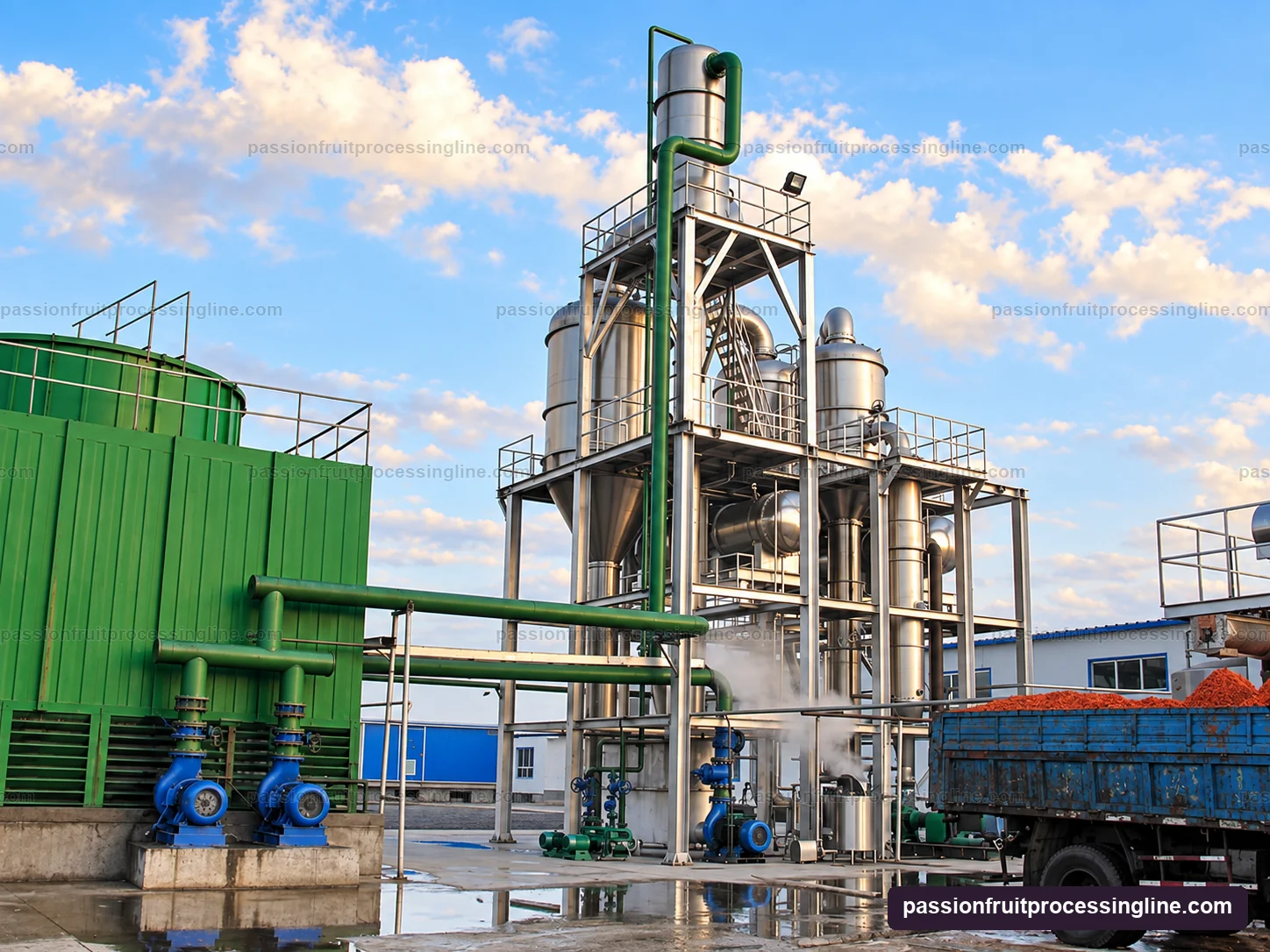
Select the evaporation form around the liquid
A falling-film arrangement distributes liquid over heating surfaces under vacuum. Stable wetting and the changing viscosity are central to its operation. A forced-circulation arrangement uses a pump to move product through a heater before evaporation in the separator, providing a different route for demanding circulation and suspended-solids conditions.
Effect count and vapor-recompression options are selected with the available steam, electricity, cooling water and seasonal operating pattern. The balance includes vapor separation, condensate, vacuum and product discharge. Aroma collection is designed as a defined part of that circuit when required; vacuum concentration does not leave the original aroma unchanged.
Coordinate air removal and thermal treatment
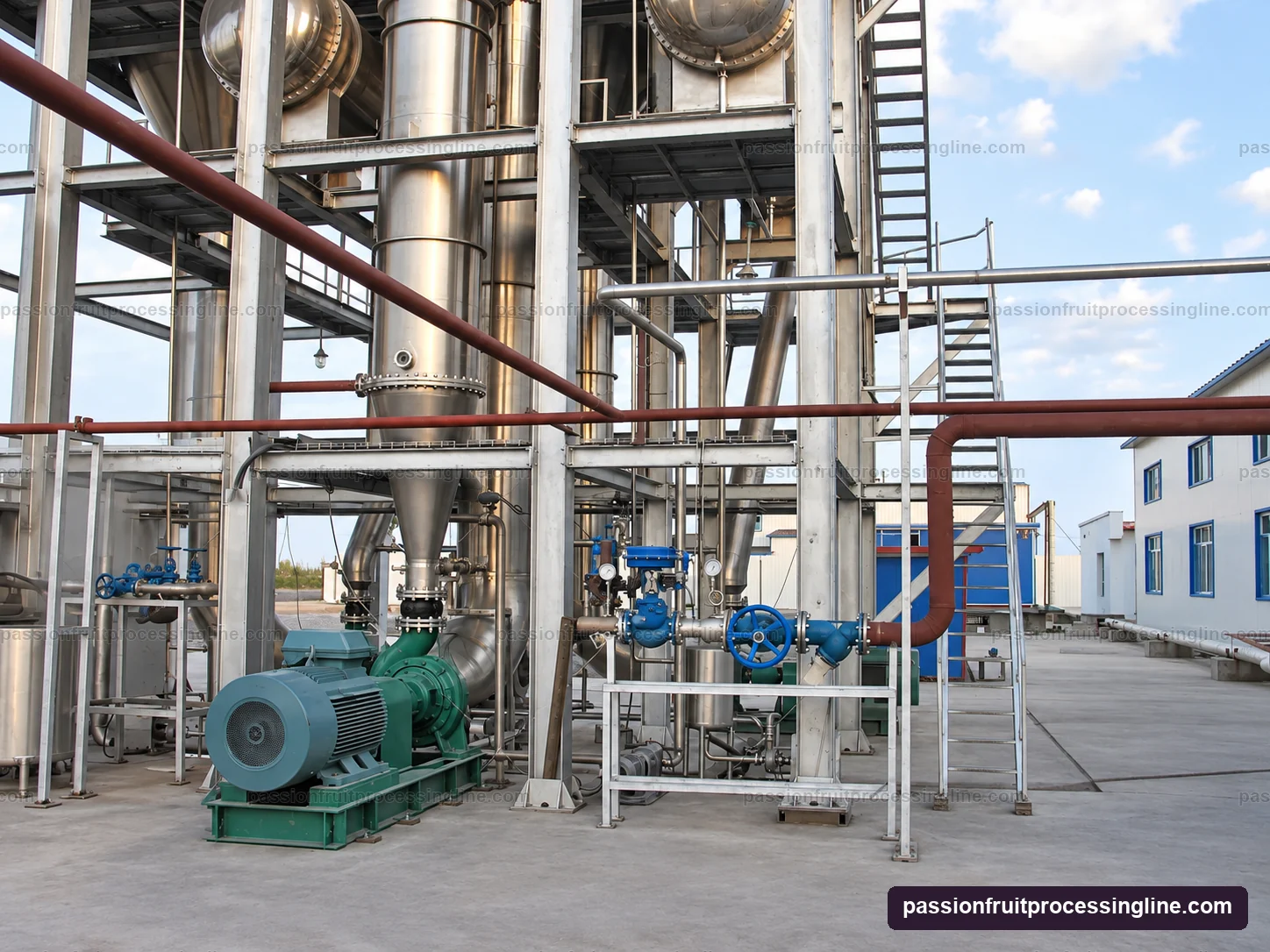
A deaerator can remove entrained air ahead of a suitable downstream operation. Its feed and discharge must remain balanced, with the vacuum chamber, condenser and pumps working as one unit. Product temperature and the handling of collected volatiles are part of the selection.
The tubular thermal system then follows the required heating, holding and cooling path. Product changes caused by concentration or heating are included in pump and exchanger selection. The control arrangement needs a defined response to inadequate treatment, low feed, a downstream stop and cleaning, so that material cannot move forward merely because a pump is running.
Connect the thermal outlet to the package
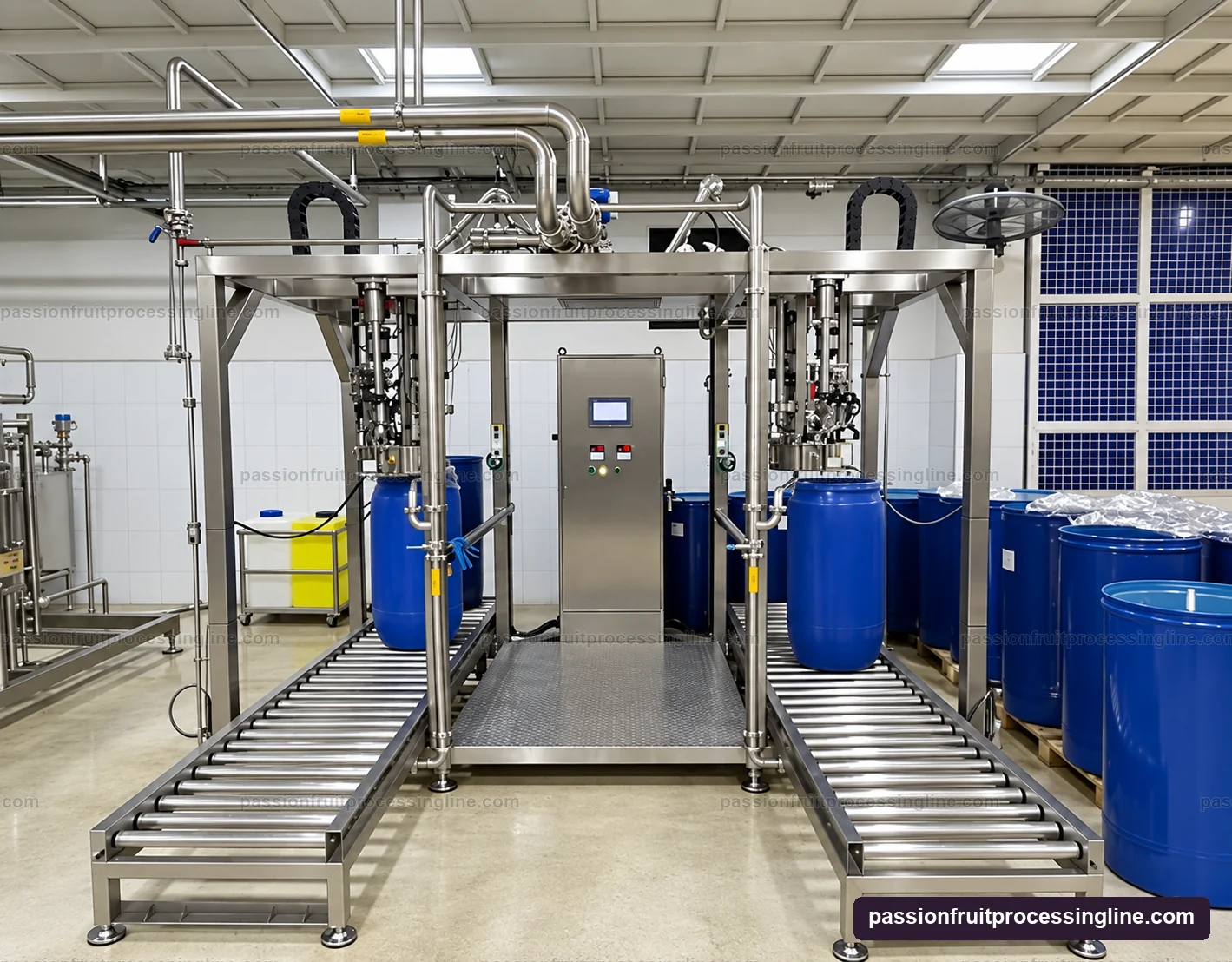
Aseptic bag filling combines the filling interface, compatible bag fitment, metering and container handling. The product reaches the filler through the defined sterile boundary; a change of bag or a stopped conveyor must be coordinated with upstream flow. Where buffering is required after treatment, its design must support that boundary rather than using an ordinary open product tank.
Drum or box handling is selected around the actual bag and shipping format. A bag-size family is not a universal list of compatible fitments or a fixed filling rate. The line balance includes the time spent presenting containers, connecting bags, filling and moving the completed package.
Engineer the working line, including changeover
Steam and cooling duties, vacuum services, electrical supply and CIP return belong in the line design. Maintenance space is needed around pumps, exchanger access, valves and the filling area, as well as around tall evaporation equipment.
Cleaning circuits follow the equipment arrangement and the product left in it. Evaporator circulation, thermal holding sections and the product pipework require appropriate return flow and drainability. Production and cleaning sequences are coordinated with the upstream supplier of prepared liquid and the downstream packaging operation.
In practice
Questions about this stage
Is an evaporator required for aseptic bag filling?
No. Concentration changes the ingredient's solids, while aseptic filling provides a packaging route after the appropriate product treatment. A single-strength ingredient can follow a route without evaporation.
Does an evaporation-capacity rating state the finished-product flow?
No. Evaporation duty describes the water removed. Feed and concentrate flows depend on their solids and the process balance, so all three quantities must be specified separately.