Keep the solids balance visible
On a simplified mass basis, feed multiplied by its solids fraction equals concentrate multiplied by its solids fraction when those solids are retained. The difference between feed and concentrate is the water-removal duty. This is a starting calculation, not an allowance for entrainment, other losses or every component of a real fruit product.
Use consistent measurements and units. A refractometer reading, insoluble pulp content and total solids do not describe exactly the same property. Volumetric flow also requires the density at the stated condition before it can be combined with a mass balance.
| Quantity | Meaning | Common confusion |
|---|---|---|
| Feed flow | Prepared liquid entering the evaporator | Not whole-fruit intake |
| Concentrate flow | Product leaving at the selected solids | Not the nominal evaporator capacity |
| Water removal | Water evaporated over the operating period | Not the amount of juice processed |
| Pulp and viscosity | Material behaviour at relevant process conditions | Not determined by Brix alone |
Account for starch and suspended material
Passion fruit can contain starch that changes the liquid's viscosity during heating. Concentration increases the solids load as well, so the feed condition does not describe the entire path through the evaporator. Suspended pulp, fibre and any retained particles further affect circulation and heat transfer.
The intended ingredient determines whether a separate upstream treatment is appropriate. Such treatment is a product and process decision rather than an automatic requirement of every line. Evaporator selection should use representative material at the relevant concentration and temperature.
Compare film formation with forced circulation
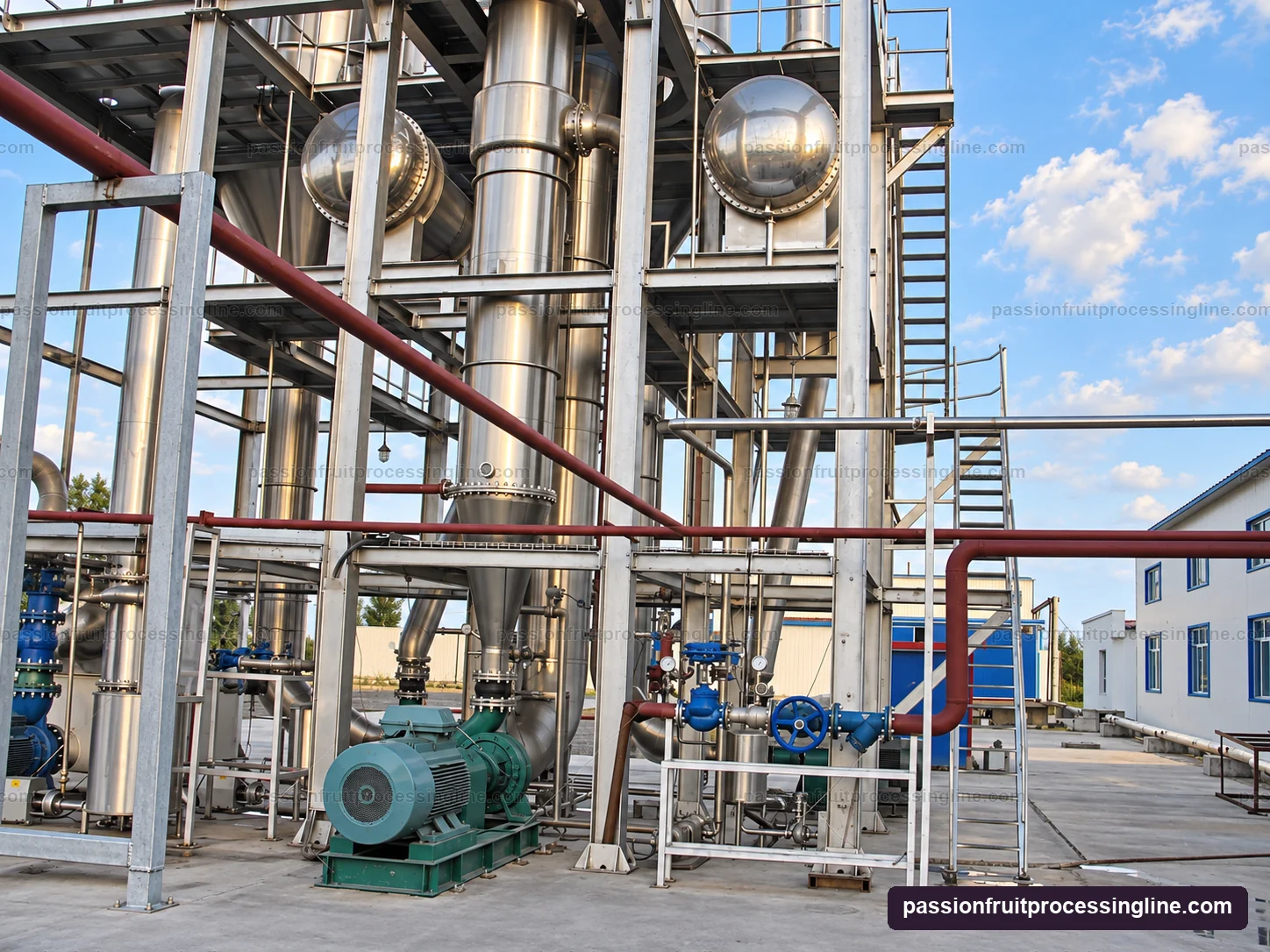
A falling-film system relies on controlled liquid distribution and continued wetting of the heating surface. The design addresses the changing viscosity and the operating range needed to maintain that film. Vapor separation and the condenser support the vacuum process.
A forced-circulation system pumps product through a heater and into a separator where flashing takes place. Pumping, pressure loss and circulation are central to the design. The suitability of either form depends on the actual product and duty, not simply whether the line is described as juice or pulp.
Include the utility and aroma circuits
The number of effects and any vapor-recompression option are selected with the heating source, electricity and cooling supply. The condenser must handle the vapor duty under the site's cooling conditions, while discharge and control maintain the required product flow.
Volatile collection and any aroma return need an explicit configuration. Neither a multi-effect arrangement nor a vacuum setting establishes an energy-saving percentage, flavour-retention result or finished-product shelf life by itself.
In practice
Questions about this stage
Can the inlet and outlet Brix values select an evaporator by themselves?
They help define concentration duty, but selection also needs the feed flow, measurement basis, pulp and starch behaviour, viscosity across the process, fouling tendency and utility conditions.