Measure capacity at the point it belongs
Receiving capacity describes whole-fruit mass. After shell and seed separation, downstream sizing uses the actual recovered liquid flow and its composition. The conversion depends on fruit condition and the chosen product; it should not be replaced with a fixed recovery percentage.
At concentration, the balance changes again. Product flow decreases as water is removed, while viscosity and pressure loss may increase. The filling section then works with net product per package and a cycle that includes container and bag handling.
| Design quantity | Unit basis | Use |
|---|---|---|
| Fruit feed | Mass per hour | Preparation and opening duty |
| Prepared juice/pulp | Mass or volume per hour at stated condition | Transfer, buffering and thermal selection |
| Evaporation | Mass of water removed per hour, or the supplier's explicitly stated basis | Evaporator and utility duty |
| Packing | Net mass/volume per bag and bags per operating period | Filler cycle and container movement |
Buffer flow, not uncertainty
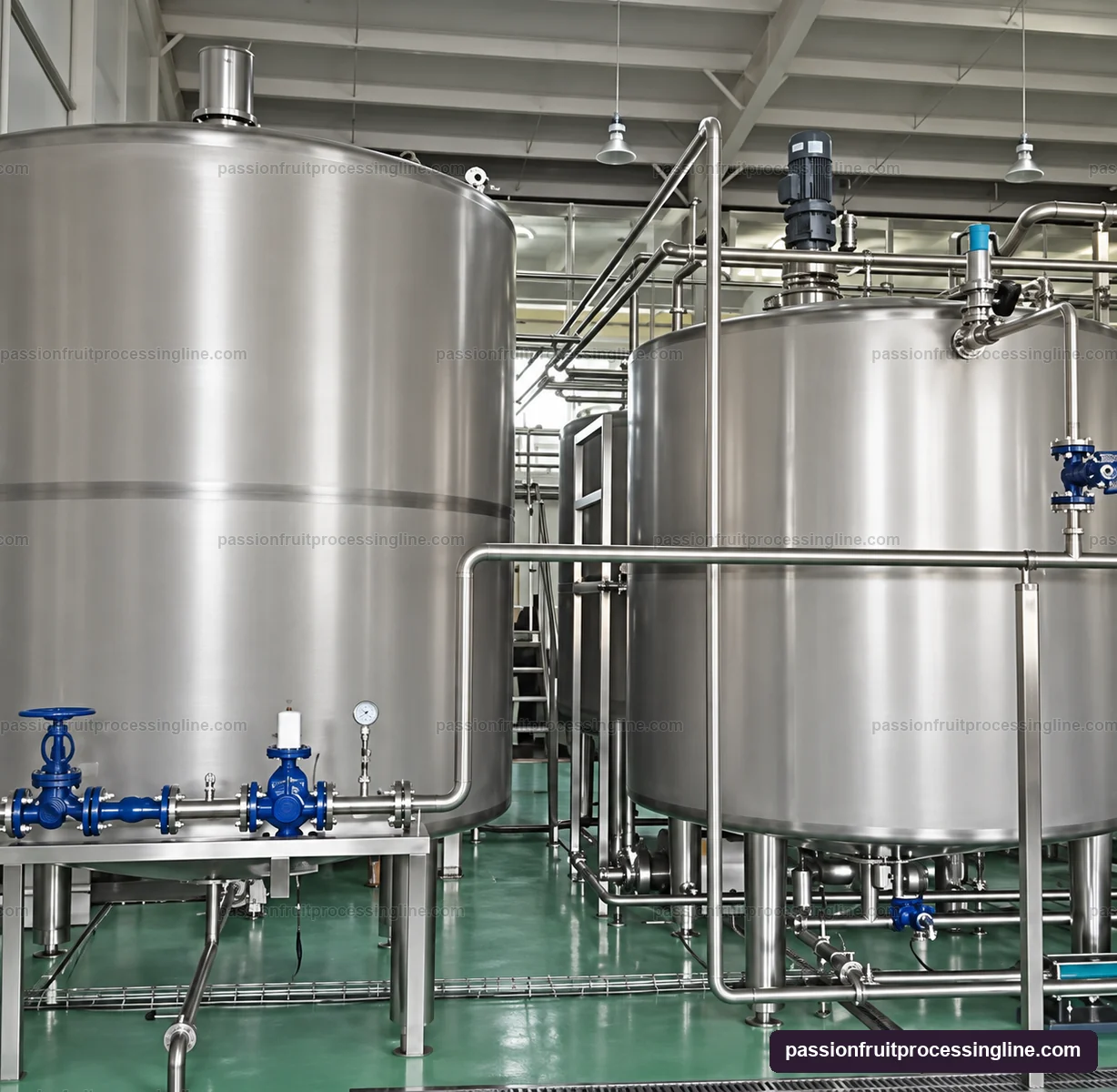
A buffer absorbs defined short variations between sections. Working volume is determined by the imbalance and the allowed holding time, with level controls coordinating feed and discharge. Product left below a pump's reliable suction level does not count as usable buffering.
An upstream run signal, low-level stop, downstream ready signal and fault response establish how adjoining equipment behaves together. Any bypass or recirculation route must have an intended destination and cleaning path.
Size services for the chosen duty
Thermal processing needs an appropriate heating source and cooling supply. Evaporation adds condenser and vacuum duties as well as its heating requirement. Ambient conditions and available cooling-water temperature influence the duty that can be sustained.
Electrical loads include drives and pumps throughout the line. Instrument air and other services belong only where selected actuators or equipment require them. Utility consumption is established from the selected design and operating conditions, not from a whole-line marketing capacity.
Leave space for work around the machine
The layout allows access to conveyor surfaces, opening and shell-discharge areas, finisher screens, pump seals, control cabinets and heat-exchanger connections. Tall evaporation equipment also needs installation and service access appropriate to its actual arrangement.
Floor drainage handles open preparation wash water; closed CIP circuits have deliberate supply and return routes. Product, reject and cleaning movements are considered together so that a convenient pipe connection does not create an inaccessible or poorly drained section.
Trace an operating change to the affected section
When output or product condition changes, identify the affected batch and compare the operating records before adjusting equipment. Fruit variation, a restricted passage, an unstable feed and an inaccurate measurement can produce similar symptoms. Inspect equipment under its supplied isolation procedure and follow the site's product-disposition rules for off-condition material.
| Observed change | Checks at the relevant boundary |
|---|---|
| Lower recovered flow or more seed fragments | Compare fruit condition, opening output, finisher feed, screen condition and the product/reject balance. |
| Foaming or an unstable liquid supply | Check buffer level, pump inlet conditions, transfers and the deaerator's recorded operating conditions. |
| Rising viscosity, pressure drop or uneven concentration | Compare the feed specification, product temperature history, circulation and the solids measurements. |
| Thermal condition or filling-cycle deviation | Review product flow, treatment records, downstream readiness and the package-handling sequence. |
| Incomplete cleaning or retained residue | Check the selected circuit, return conditions, drainage and accessible surfaces that need separate attention. |
Make acceptance relate to the delivered scope
A mechanical or water run can establish assembly, rotation, circulation and control behaviour. A product run addresses the material-specific conditions: separation, flow stability, heating response, package handling and cleaning after production. These are different tests with different conclusions.
An acceptance basis identifies the equipment included, input condition, operating period, measurement points and expected outputs. Records then describe what was actually tested rather than treating an unloaded run as proof of finished-product performance.