Reduce avoidable air entry before adding equipment
Splashing at a transfer, a poorly flooded pump inlet and unnecessary exposed holding can introduce air or increase product contact with it. Collection and buffer geometry, liquid level and transfer arrangement therefore contribute to air management before a deaerator is considered.
Entrained bubbles, foam and dissolved gases are related but different conditions. Their effect on pumping, heating or filling should be assessed at the point where the process is affected.
Balance the chamber, condenser and pumps
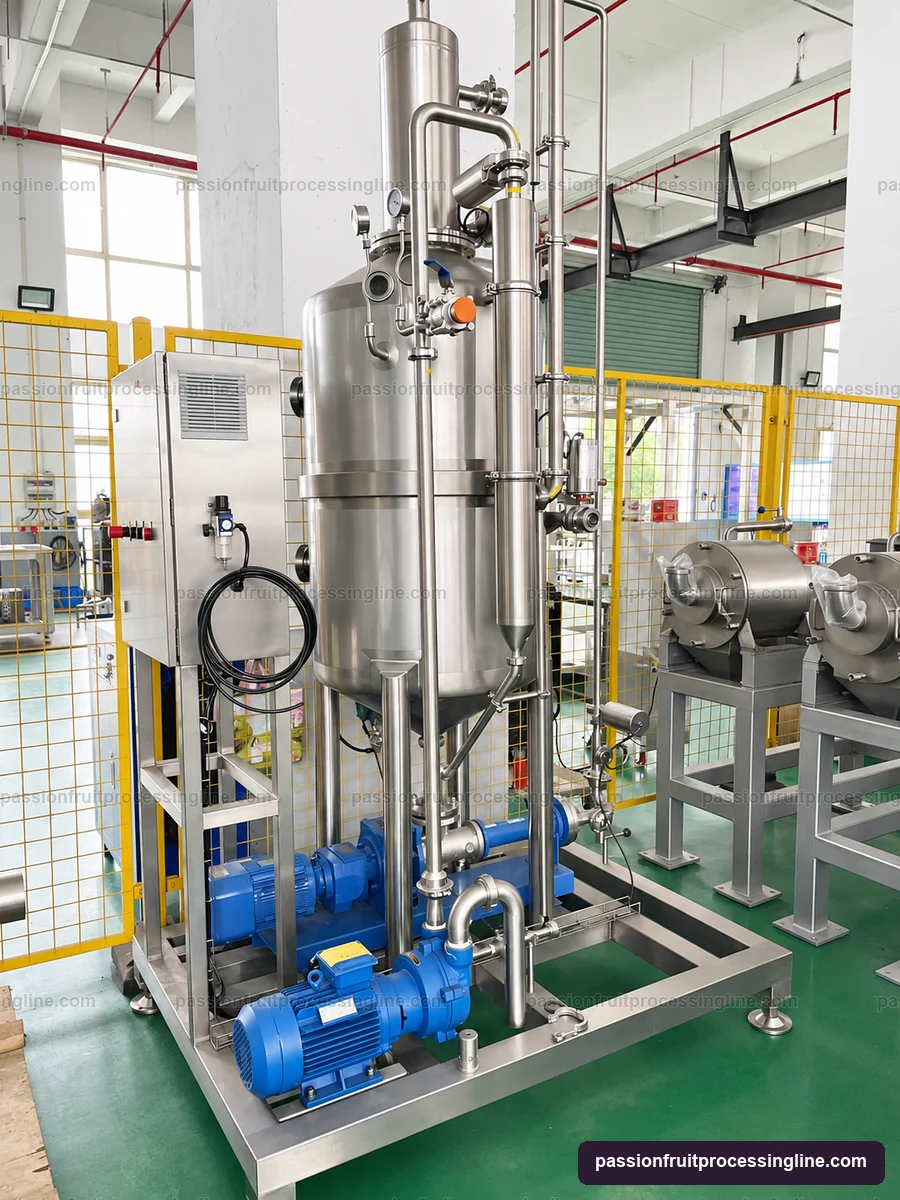
In a vacuum deaerator, reduced chamber pressure promotes gas release from the distributed liquid. A condenser handles vapor and collected volatiles, while the discharge arrangement maintains liquid movement out of the vessel. Feed, vacuum and liquid level need to remain coordinated.
Product temperature, viscosity and distribution influence the operation. The selected configuration defines how condensate and any recovered aroma fraction are handled. Gas removal is not a guarantee that all aroma stays in the product.
Concentration adds a second volatile-handling duty
Evaporation intentionally removes water as vapor. Some aroma components can travel with that stream, so the condenser and any aroma-recovery arrangement form part of the concentration design. The recovered fraction and its return point need to suit the product and sanitary boundary.
The evaporation form, product temperature and residence conditions all affect the processing history. A low-pressure operation should not be described as having no flavour effect merely because its temperature is lower than atmospheric boiling.
Evaluate the product through the complete route
Compare representative material before and after the relevant operations, including transfer, vacuum processing, heating and packaging. Sensory evaluation and suitable product measurements answer different parts of the question; a vacuum reading alone cannot describe flavour retention.
Keeping transfer times and operating conditions identifiable makes the comparison more useful. It also helps distinguish a change caused by the fruit batch from one caused by the process.