Connect the exchanger to the complete product path
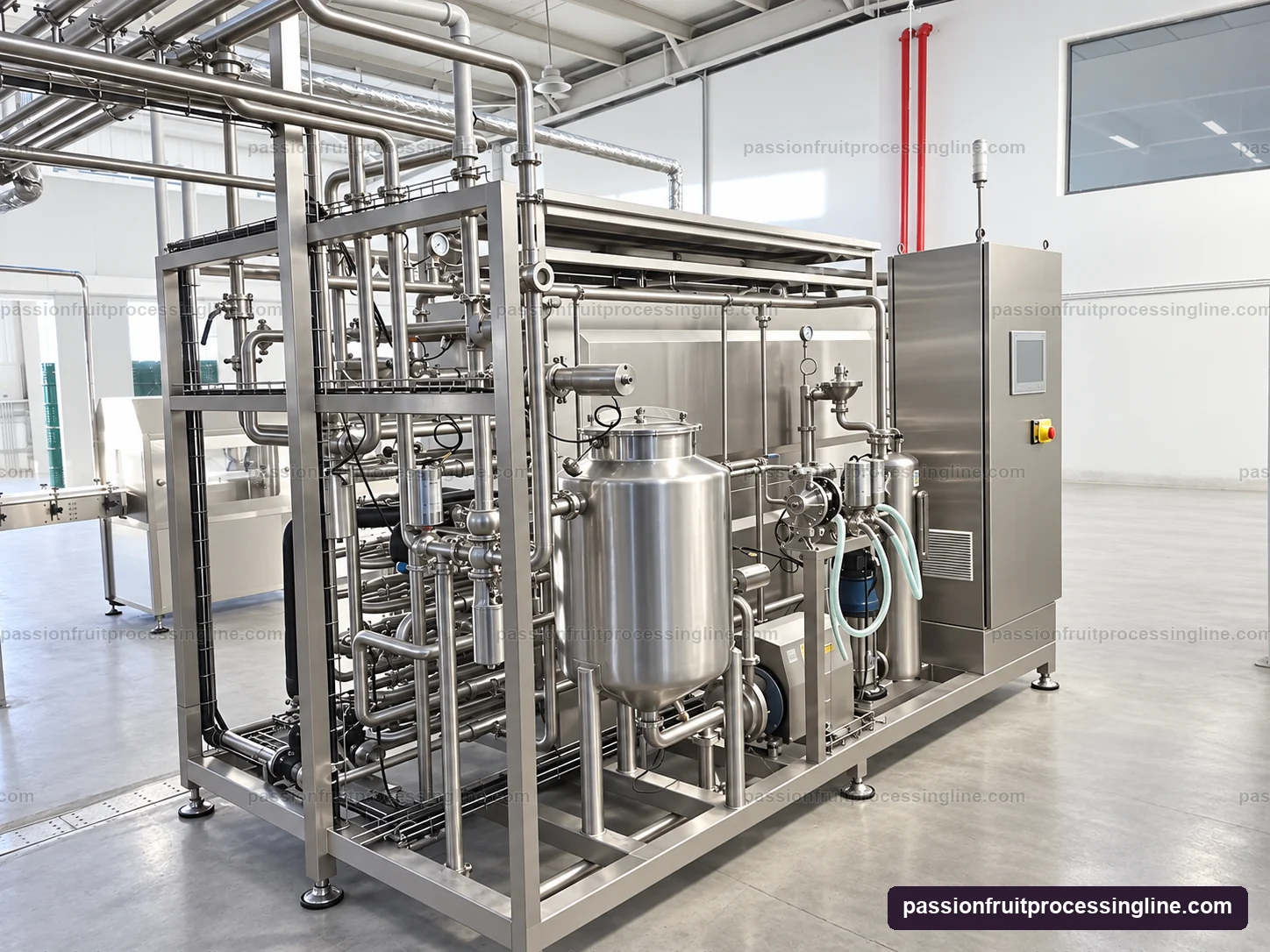
The equipment arrangement includes tubular pipe banks, a central vessel, pumps and a control cabinet. The selected system drawing establishes the heating, holding and cooling sections and the product route between them.
Passion fruit pulp content, starch behaviour and viscosity at temperature influence transfer and heat exchange. A pumpable cold feed is not enough to define the hot operating condition. Assess the intended juice or concentrate over the actual process range, including acceptable particles and any changes in consistency.
Tubular family configuration references
The temperature and time limits are general catalogue references, not independently selectable guarantees for every product or one photographed unit. The target treatment is established for the actual formulation, product properties and intended packaging route.
| Catalogue item | Family reference | Application boundary |
|---|---|---|
| Temperature range | 72–150 °C | Catalogue envelope across configured duties; not a passion fruit recipe |
| Holding-time range | 15–120 s | Catalogue envelope; effective holding condition depends on the selected system and flow |
| Heating medium | Hot water or steam | Specify the utility interface for the selected process |
| Cooling medium | Cooling water or chilled water | Select against the required product outlet and site utilities |
| Product-contact material | SUS304 or SUS316L options | Agree the actual material specification and cleaning compatibility |
Specify treatment control and off-condition handling
Define the measurement points, allowable operating window, flow controls and the action taken when conditions fall outside the established process. Identify the holding section on the drawing and relate its duty to the selected product flow.
Startup, product changeover and shutdown also need defined routing. The line should not rely on an operator assuming that all liquid passing through a warm exchanger has received the required treatment. Agree the control functions and process records during technical specification.
Match the outlet to the selected filling route
An aseptic filling route requires an agreed boundary from treatment through sterile transfer and filling. Specify the downstream condition, buffer arrangement if present, cleaning and sterilisation procedures, and how the process is maintained during interruptions.
A different packing or storage route may use a different treatment and outlet condition. Avoid fixing a temperature solely from the word juice or concentrate; the packed-product requirements and process validation determine the operating duty.
Plan cleaning around the real product load
Pulp deposits and changing viscosity can affect pressure drop and heat transfer during a production run. Establish the cleaning sequence, acceptable run condition and inspection requirements using the intended product.
Include exchanger circuits, holding pipework, pumps and valves in the return-path drawing. Cleaning flow and utility duty should be calculated for those circuits, while removable components retain the access needed for inspection and service.
In practice
Questions about this stage
Can a catalogue temperature and time be used directly for production?
No. The family ranges describe configurable equipment. The process must be established for the real product, flow, formulation, packaging and storage conditions, with the relevant controls and validation.