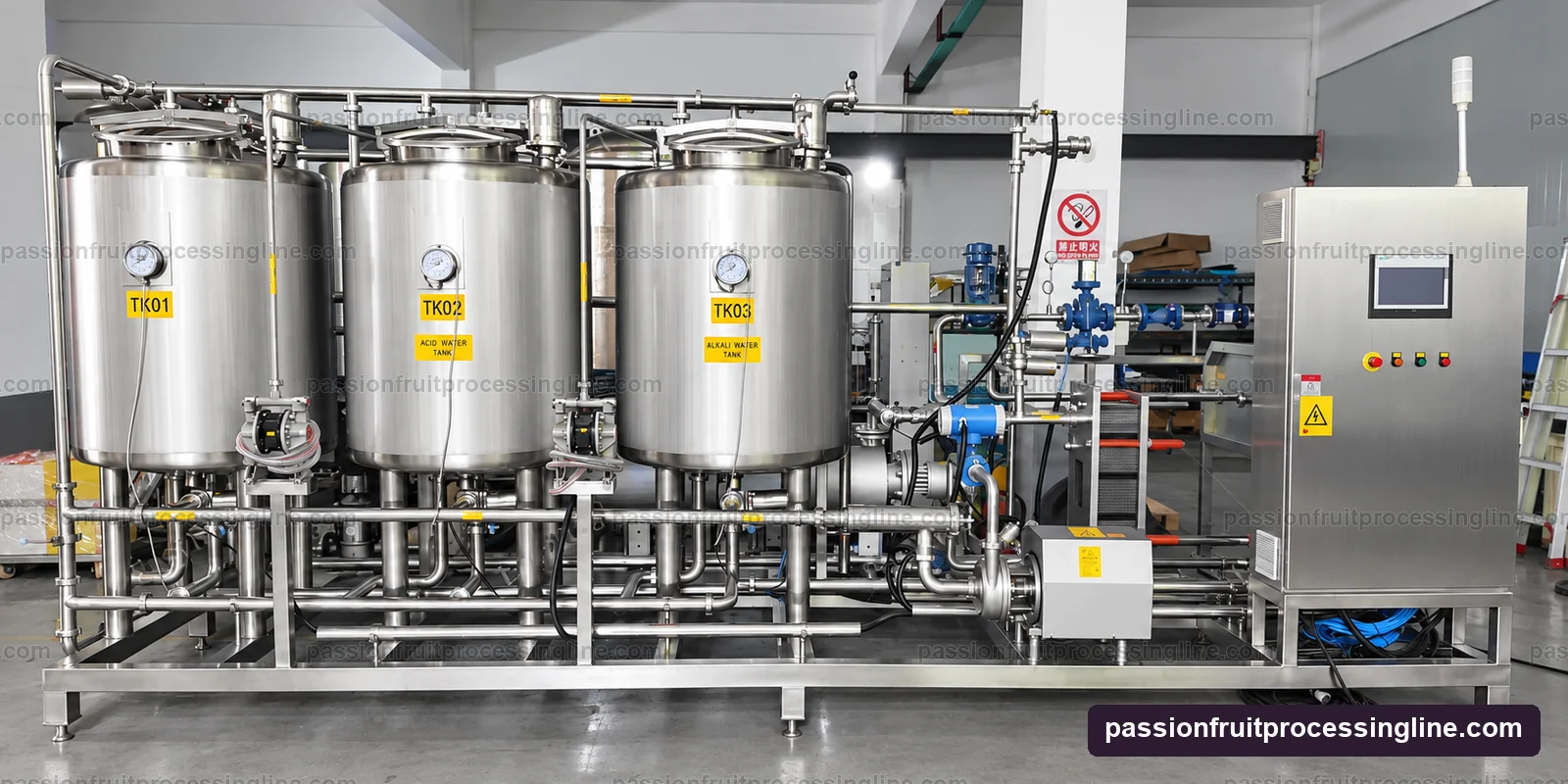
Connect the station to defined cleaning circuits
The supply pump sends the selected cleaning fluid through an agreed route and back to the station or drain. Circuit valves, heating arrangement and controls establish the sequence, while the return path provides the information needed to assess the connected duty.
Water, alkaline cleaning, acid cleaning and recovery are possible functions within a configured system. Function names do not state the physical tank count or mean that every solution is recovered. Specify tank allocation and recovery rules according to the actual plant cleaning plan.
Design around pulp, seed fragments and heated deposits
Passion fruit residues differ between the cold collection area, a pulp line and heated concentration or treatment equipment. Remove gross residues where required before circulating fluids through a circuit that could otherwise carry fragments into restrictions.
Closed tanks, transfer pipework and thermal equipment need their own flow and return assessment. Open brush beds, sorting belts and accessible finisher components may require separate washdown, removal or inspection procedures. A CIP connection is not proof that every surface is cleaned.
Define each circuit at its limiting section
| Circuit input | Purpose |
|---|---|
| Equipment and pipe route | Identify all product-contact branches, valves, low points and return connections |
| Required cleaning flow | Establish the supply and return duty for the selected route |
| Heating and chemical conditions | Match the residues, materials and approved cleaning procedure |
| Return monitoring | Select measurements such as temperature or conductivity where required by the procedure |
| Drain and recovery routing | Prevent incompatible returns and retain a defined final-rinse path |
| Verification | Agree inspection, records and hygiene acceptance criteria for the circuit |
Keep production and cleaning routes under control
Specify the valve states and interlocks that separate cleaning fluids from product during each operating mode. The process drawing should show the intended route through equipment and how transitions are controlled.
Chemical concentration, temperature, circulation time and rinse criteria should follow a validated procedure for the installed circuit. A universal recipe cannot account for all product residues, materials or pipe geometries. Sterilisation duties for an aseptic section require their own defined procedure and compatible configuration.
Provide access for checks that circulation cannot replace
Tank interiors, instruments, seals and selected dismantled components need appropriate inspection and service access. Record the items that require manual attention alongside the automated sequence so they remain part of routine operation.
Agree utility demand, chemical handling provisions and wastewater routing with the site. Those interfaces determine how the cleaning station fits into daily production and how its return streams leave the processing area.
In practice
Questions about this stage
Can the same CIP sequence clean the entire fruit line?
Not automatically. Define separate circuits and any manual-cleaning duties for receiving, opening, finishing, liquid handling, thermal processing and filling. Each needs suitable access, compatible conditions and its own cleaning acceptance criteria.