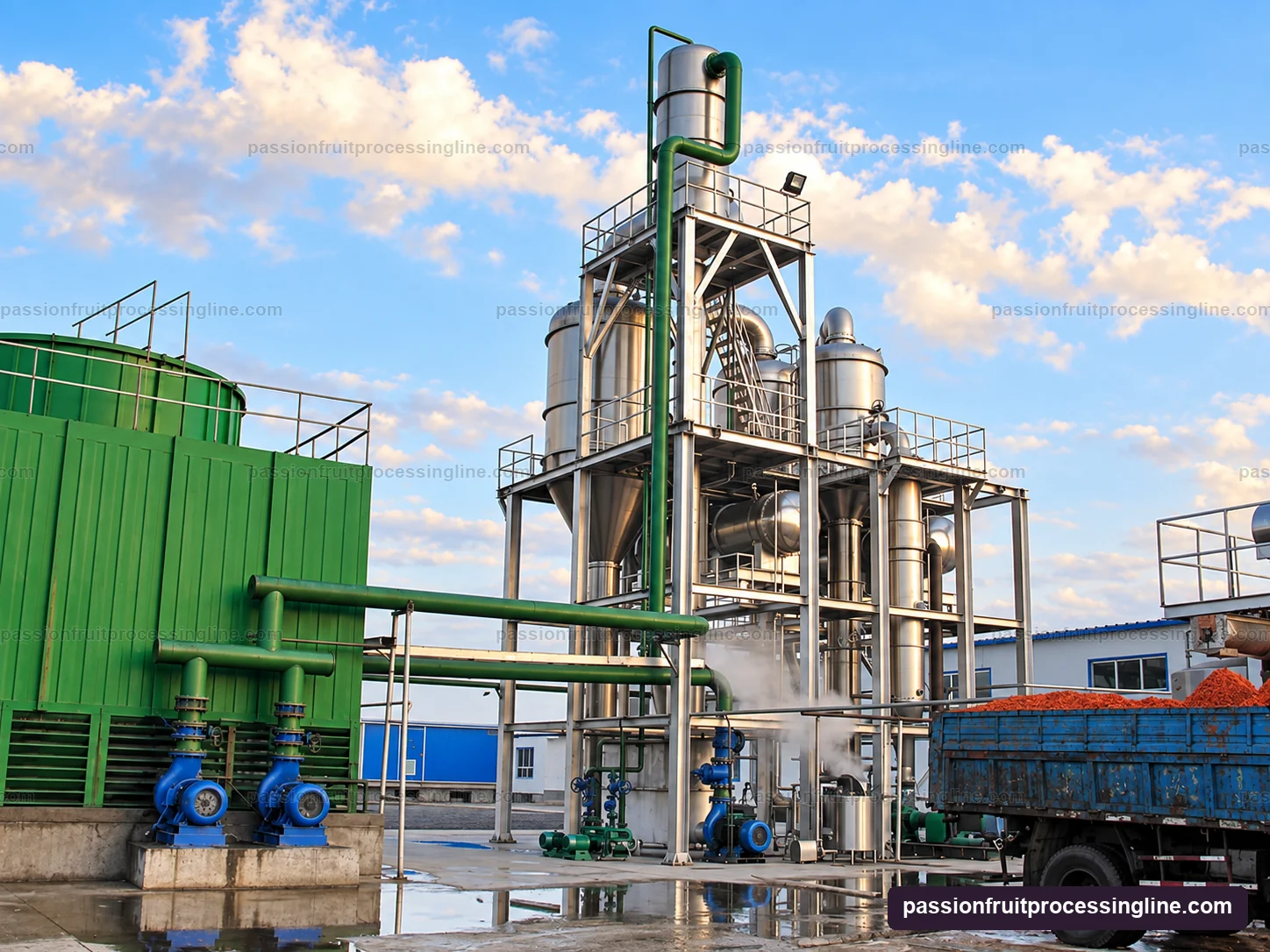
Build the process around heat transfer and vapour separation
The evaporation system combines heating surfaces, vapour separation, a vacuum arrangement and product handling. Its installation also needs accessible pumps and valves, utility pipework and space for the cleaning and service routes.
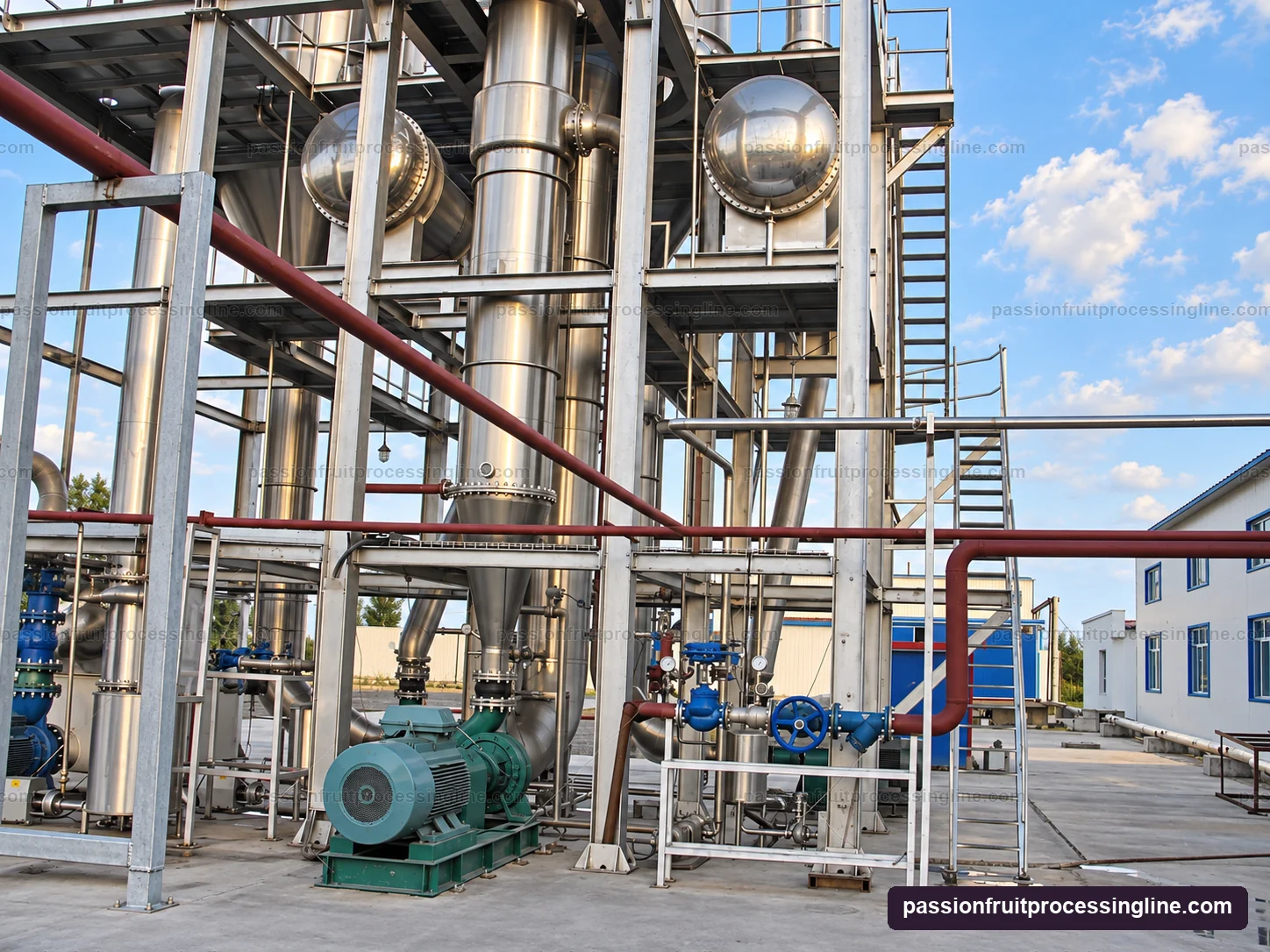
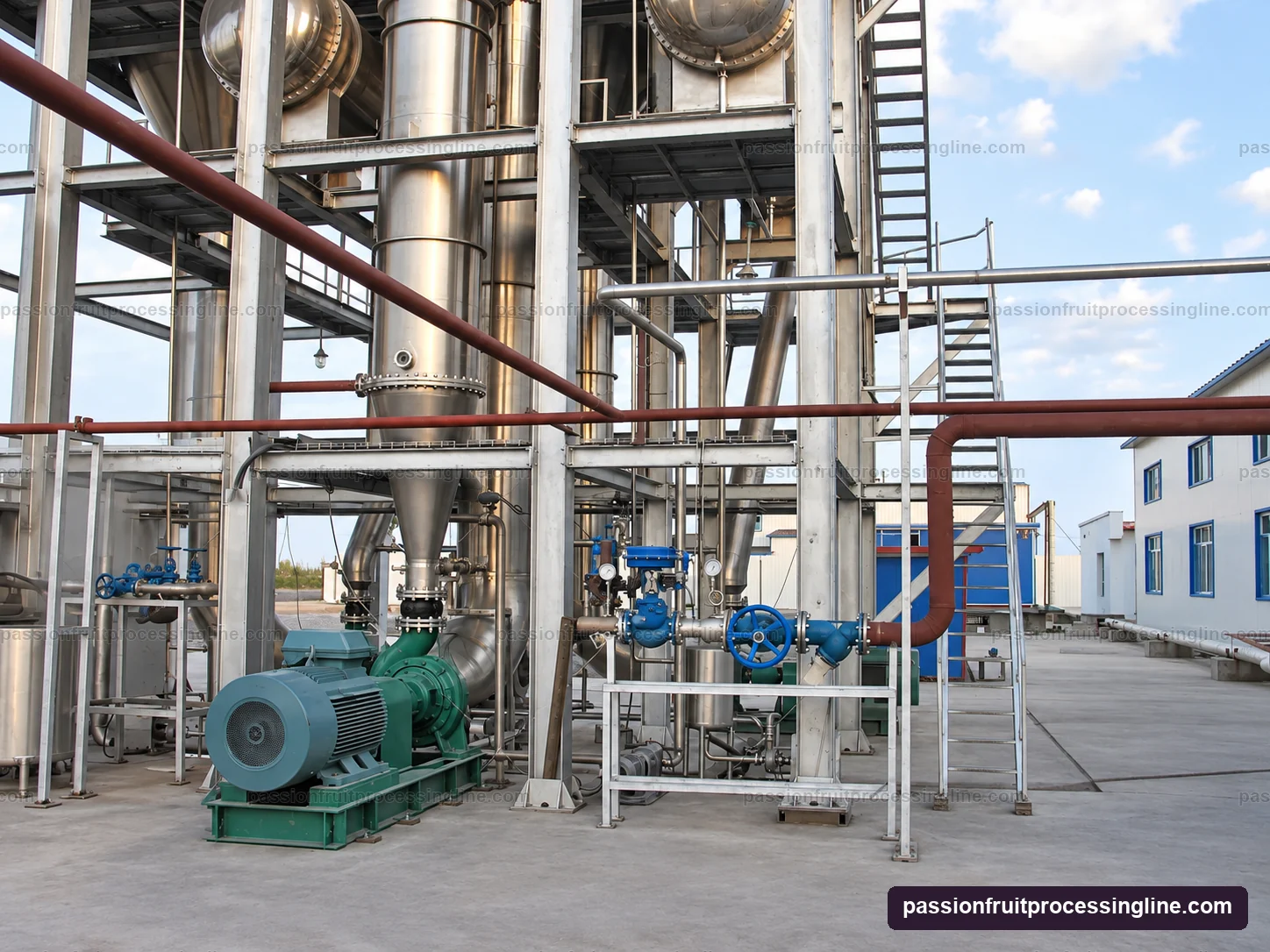
The installed equipment and circulation views illustrate the space around the vessels and lower service components. The selected flow diagram and heat-transfer design establish the actual process configuration, water-removal duty and utility connections.
Compare the liquid behaviour each arrangement must handle
Passion fruit feed can contain pulp and starch that change its behaviour during heating and concentration. Establish the prepared feed specification before comparing configurations. An evaporator selected only from a nominal hourly feed figure can miss the limiting heat-transfer or circulation condition.
| Arrangement | Operating principle | Selection focus |
|---|---|---|
| Falling film | Liquid is distributed as a film over the heating surface under vacuum | Reliable distribution and wetting at the intended viscosity, flow and solids load |
| Forced circulation | A pump circulates product through a heater before evaporation in a separator | Circulation requirement, viscosity development, pressure conditions and product response |
| Effect and vapour system | The selected effects and vapour arrangement organise heat use | Available utilities, water-removal duty, control range and project-specific energy balance |
Separate juice feed from water evaporation
State feed mass flow, feed soluble solids, target soluble solids and the intended concentrate output. Water-removal duty is a separate result of that balance. Keep mass flow and volumetric flow distinct, especially when density changes through concentration.
For a preliminary balance with soluble solids conserved, concentrate mass flow equals feed mass flow multiplied by feed solids fraction and divided by outlet solids fraction. Evaporated water is the difference, before accounting for entrainment, transfers or other losses. Actual equipment selection also needs the product temperature and viscosity profile.
Define aroma handling and utilities before fixing the package
Specify how vapour, condensate and any aroma recovery stream are handled. Their destination and treatment should be part of the process diagram, with finished-product quality criteria agreed for the intended concentration. Vacuum operation alone does not guarantee aroma retention.
Include the heating supply, cooling and condenser load, vacuum equipment, electrical demand and cleaning sequence in the utility schedule. Any thermal or mechanical vapour-recompression option needs its own applicable duty and energy calculation.
Connect concentration to the required packing process
Concentration changes product consistency and downstream handling. Recheck transfer pumps, buffer conditions and thermal treatment against the concentrate, rather than carrying forward assumptions from single-strength juice.
The selected storage or filling route still requires its own product treatment and hygiene controls. An evaporation duty is not a shelf-life specification or a substitute for validating the final packed product.
In practice
Questions about this stage
Is evaporation capacity the same as juice feed capacity?
No. Evaporation capacity describes water removal on a stated basis. Juice feed and concentrate output depend on the inlet and outlet solids and the other terms in the mass balance. Quote all three separately.