Three measurements answer different questions
Specifications should identify the sampling and measurement method. A visual sample, a sieve result and a soluble-solids reading are not interchangeable, even when all are described informally as product quality.
| Attribute | What it describes | Equipment implication |
|---|---|---|
| Seed content and condition | Intentional seeds, unwanted seeds or broken fragments | Opening, separation route and downstream passage |
| Suspended pulp and fibre | Insoluble material carried by the liquid | Screen selection, texture, pumping and heat transfer |
| Soluble solids | The dissolved-solids basis used for a juice or concentrate specification | Concentration duty and ingredient consistency |
| Shell specks or foreign material | Unwanted carryover from preparation and opening | Inspection and separation performance |
A finisher works on the material it receives
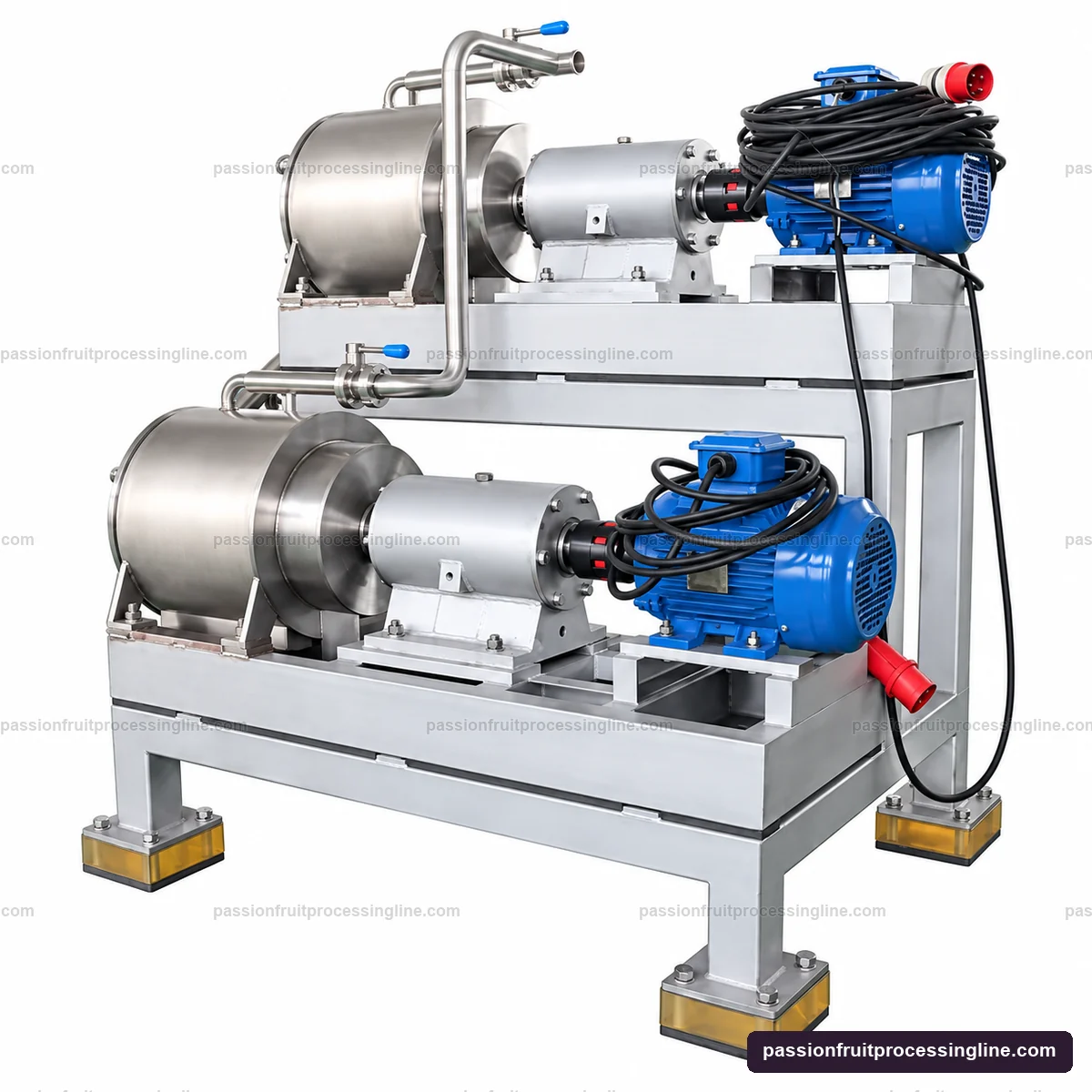
The two-stage refining assembly provides successive screened separation. The input should already be released from the shell. Screen geometry and operating conditions act on that feed, with usable product leaving separately from retained material.
Changing the screen can alter the balance between product recovery and suspended material. Feed rate, fruit condition and mechanical action also matter, so the result is evaluated using the actual extracted seed-pulp. A model's general fruit rating is not a prediction of the finished passion fruit product.
Retaining seeds changes the downstream route too
If the product deliberately contains seeds, the selected separation route must preserve the intended inclusion rather than remove it. Transfers, valves, pumps and heat-exchanger passages then have to accommodate that product without relying on a setting developed for seed-free liquid.
The package and filling interface are included in this assessment. Product appearance, seed condition and distribution are evaluated after the relevant handling steps, not only in the collection vessel immediately after opening.
Keep the incoming fruit basis with each result
Record the fruit lot and the condition presented to preparation: size range, maturity, shell condition, holding history and the material removed during inspection. These observations put the resulting seed-pulp stream and recovery measurement in context. A result from one selected lot should not silently become the operating basis for a different seasonal supply.
For a prepared-liquid supply, retain its composition and temperature with the sample. Acidity, soluble solids, suspended material and consistency describe different properties, and the downstream product specification may require each. Link the finished sample to its input and separation conditions so a product change can be traced through the line.
Compare output and rejects on the same basis
A useful separation comparison measures input, recovered product and reject streams over the same operating interval. It then relates recovery to the agreed seed, shell and pulp requirements. This avoids rewarding a higher liquid output that contains more unwanted material.
Samples taken across a run reveal variation that a single attractive sample can miss. The agreed product definition is the reference for deciding whether a change to the feed or finishing conditions is useful.
In practice
Questions about this stage
Can a screen size guarantee seed-free product?
Screen size is one part of the separation configuration. The input material, feed rate, mechanical action and condition of the screen also influence the result. The product is assessed against its seed and fragment specification using representative operation.